
The watery component of tears is mainly produced in the lacrimal gland (glandula lacrimalis).
Tears moisten the eye and are then absorbed through the puncta (small openings in the eyelids). With each blink, the tears are pumped through the tear ducts into the lacrimal sac. From the lacrimal sac, the tears then flow into the nose. This is why you need to swallow more often when you cry.
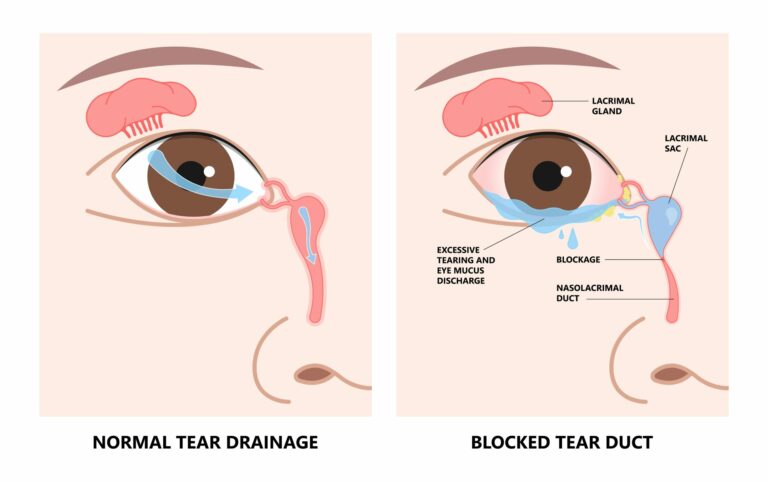
Congenital nasolacrimal duct obstruction is a narrowing or blockage of the tear ducts present at birth, which prevents the normal drainage of tears from the eye into the nose.
It can be recognized by excessive tearing and recurring infections around the affected eye.

Congenital nasolacrimal duct obstructions are very common. In most cases (90%), the tear ducts open on their own during the first year of life. This process can be supported by gentle massage.
After the first year of life, the likelihood of spontaneous opening decreases. At that stage, we recommend opening the tear ducts through probing — the insertion of a hair-thin cannula — followed by flushing. In some cases, we may also recommend the temporary placement of a small silicone tube. This tube acts as a temporary stent for the tear ducts and is removed after a few weeks.